
E-Invoice Automation: The Next Step in Business Efficiency
2026-03-27
Introduction
It comes to a stage where small inefficiencies begin to accumulate in every business. A couple of overdue payments here, a small calculation error there, and all at once it turns out that billing is a bottleneck rather than a routine job. This is precisely the reason why the e-invoice is becoming a topic. It does not simply mean substituting paper with screens. It is concerning to reconsider the role of billing within the broader scheme of business efficiency.
With companies shifting to digital invoicing and smarter systems, invoicing is not an activity that occurs at the end of a process. It integrates into an extended working process where information flows efficiently, the decision-making process is quicker, and payments are not delayed by unnecessary mistakes anymore.
What Makes E-Invoice Automation Different
On its part, an electronic invoice may appear to be a virtual copy of a paper bill. However, that is not what matters when it comes to its actions behind the scenes.
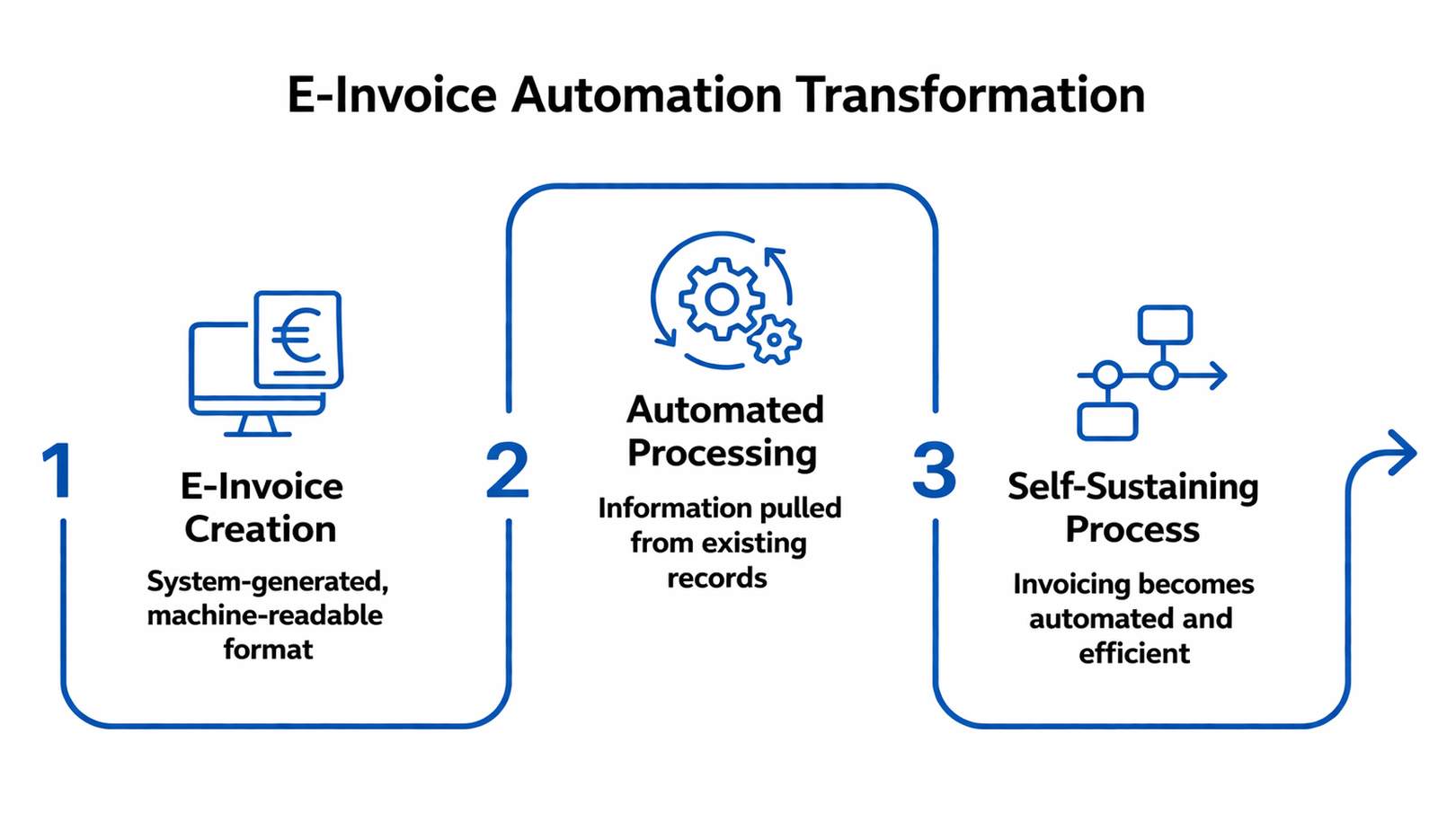
An e-invoice is organized in a way that systems can read it, process it, and even take any action without necessarily involving a human being. Once invoice automation is overlaid, the changes start becoming more apparent. The system does not require a person to prepare each payment invoice manually, as the information is pulled out of the existing records automatically, and the invoice is constructed automatically.
It implies a reduction of stepwise gaps. It also implies the reduction of the opportunities of going wrong.
In practice, automating e-invoices converts invoicing from a task into a self-sustaining process.
Why Traditional Billing Slows Businesses Down
The inefficiencies in the billing process are not realized immediately in most businesses. They grow used to them. The invoices are prepared by someone at the end of the week. Another person checks them. At this point, they are dispatched and pursued by hand.
It works, but not efficiently.
The problems tend to manifest themselves in minor forms. Checks are not being disbursed as quickly as expected. Clients ask for corrections. More time is wasted in rectifying errors than in number analysis by the finance teams, making it essential to adopt systems that help reduce errors in billing processes.
The following are the common sources of these problems:
- Re-keyboarding of data in various systems.
- Use of manual calculations.
- Inability to understand invoice status.
These minor delays begin to have an impact on cash flow and productivity as the business increases. It is at this point that businesses start considering obtaining an alternative method of handling invoice processes more reliably.
How E-Invoice Automation Changes the Workflow
Automated billing does not only concern speed. It is concerned with eliminating friction in the whole process.
When using a manual system, the invoicing process consists of a number of processes that are not related. The data is gathered, entered into templates, checked, and dispatched. Every one of the steps relies on a person being able to recall what to do.
Those steps are linked to the digital invoice processing. Information flows straight from one system to another. After recording a transaction, one can instantly generate an invoice through an invoice generator.
The system can also be equipped with approvals. Invoices take a predetermined route instead of pursuing signatures or waiting to receive an email.
This is better explained by a very simple example. Consider an example of a company that charges clients on a monthly basis. In the past, one would need to inspect contracts, create charges, and invoices individually. Using automation, the system is already aware of the billing terms. It automates and dispatches invoices on schedule.
It is not only time saved. It is consistency.
The Role of Digital Invoice Processing in Accuracy
The accuracy in billing is frequently reduced due to the processing of data. The manual procedures rely on human beings copying and checking information over and over again. It is at that point that errors are more likely to occur.
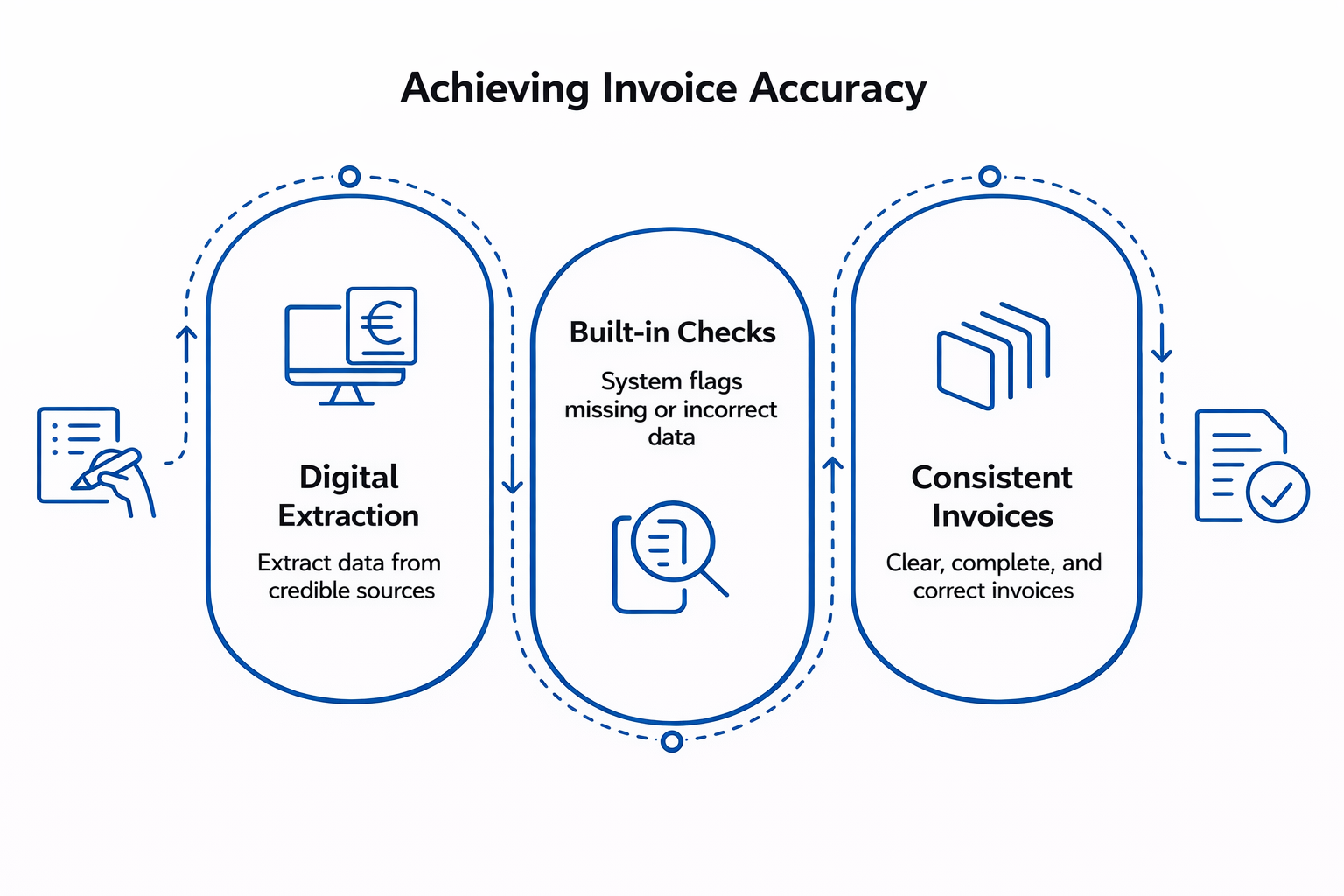
This dependency is minimized by digital invoice processing. The information is extracted right out of credible sources; hence, it is not subject to manipulation.
It also provides built-in checks. In case of any missing or non-conformance with the expected values, then the system will point this out, and the invoice will not be sent.
In the long run, this consistency creates trust. Invoices are clear, complete, and correct to the clients. Inside the firms, finance departments do not waste as much time on argument settlement cases; instead, they take time to do deep work.
Where Tools Like Invoice Generators Make a Difference
Not all businesses are initiated on a fully automated basis. Some of them start with less complex applications, such as an online invoice generator or invoice creator.
Such tools can be considered simple, yet they address frequent issues immediately. They standardize the formatting, do the calculations, and store customer information so that they do not have to be entered again and again.
This can be a turning point for the freelancer or a small business owner. They do not have to be preoccupied with whether numbers are added and facts omitted, but with the help of the tool, they can trust the structure to be handled.
It tends to be the initial move towards a more rigorous digital invoicing change.
The Impact on Payment Cycles
The speed at which payments flow is one of the most evident changes that are experienced upon adoption of e-invoice automation.
Payment is normally delayed when the invoicing is delayed. In case of a late invoice or an invoice with mistakes, the payment schedule will automatically change.
In the case of automated systems, invoices are sent on time and in the right format. It allows clients to look at them and work on them without any superfluous back-and-forth.
The visibility is also enhanced. When a payment invoice has been viewed or approved, businesses can know that, hence, follow-ups are more informed and less frequent.
With this type of transparency, the cash flow will remain constant, which is essential to expansion.
Cost and Efficiency: The Hidden Gains
In case the businesses consider cost-saving, they tend to consider blatant expenses. However, there are also invisible expenses involved in invoicing.
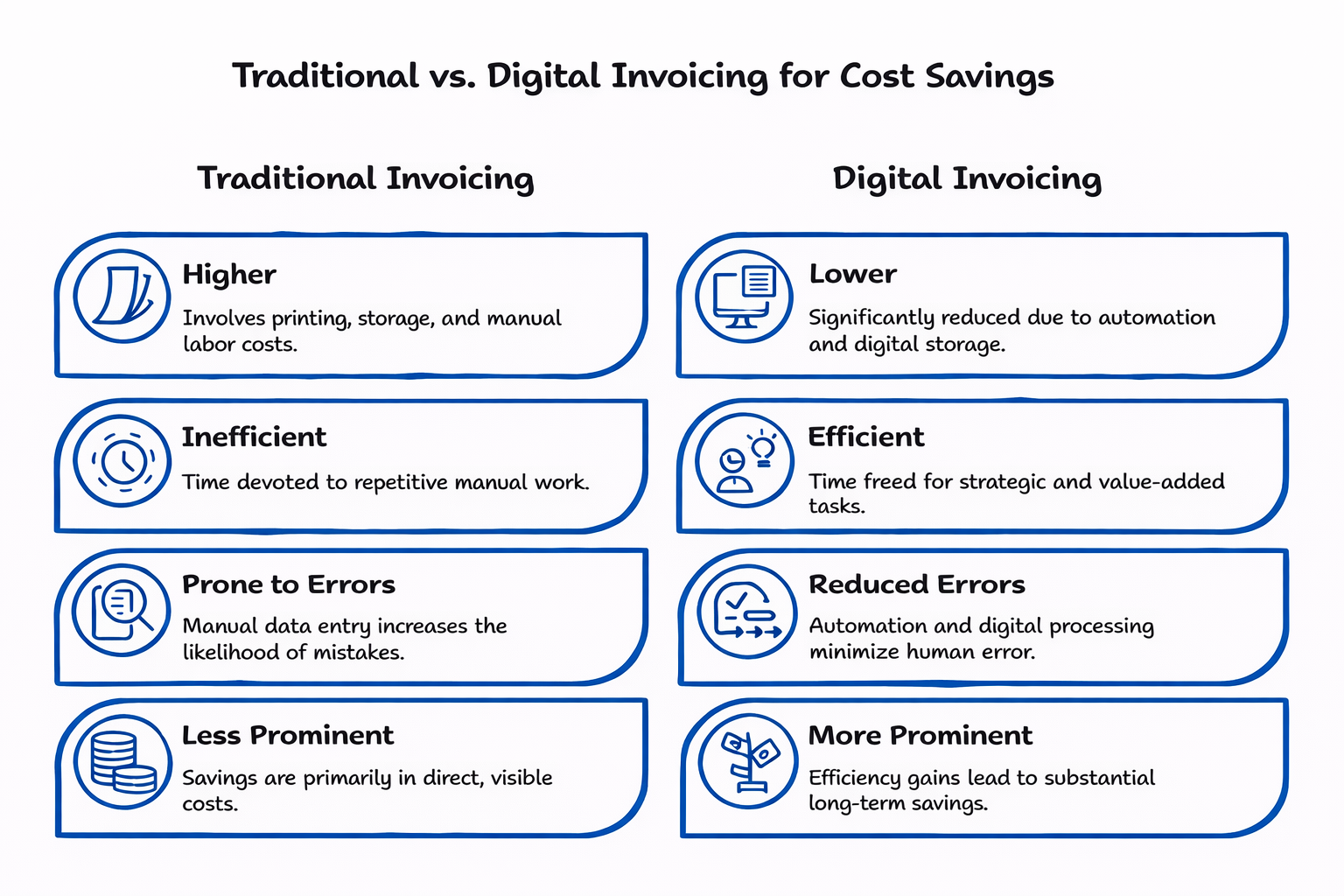
Operation expenses also include printing, storage, and manual labor. More to the point, the time that is devoted to repetitive work is the time that should not be devoted to strategic work.
These hidden costs are lowered by digital invoicing solutions designed for efficiency and scalability. Workflows are accelerated, and the amount of work that is done reduces errors, and teams are able to manage more work without necessarily increasing resources.
The savings realized in the efficiency gains are more prominent in the long run than the actual savings.
Compliance and Data Confidence
Given the changing regulations, businesses are supposed to be able to keep proper financial records that are readily available. This is more difficult than it should be made out to be by manual systems.
E-invoice systems ease compliance as everything is organized and tracked. A record of the creation time, modifications, and approvals of each invoice is clear.
Such disclosure comes in handy when auditing. Businesses will be able to access records in real-time as opposed to searching through files or emails.
Security also improves. Digital systems restrict access to or editing of data, thereby lessening the chances of unauthorized alterations.
Real-World Shift: A Practical Scenario
Take the case of a distribution company of size (handling hundreds of transactions weekly). Their finance department would take days to prepare invoices, and the information would not always match, and would take a long time to get approval.
With the deployment of e-invoice automation, things were different. Sales information was fed into the invoicing system. Invoices were created automatically, and order matching was sent automatically.
In several months, billing errors also reduced drastically. More to the point, the team was able to devote some time to the performance analysis rather than to corrective actions.
It is here that the actual worth of automation is seen.
Common Challenges and How They Are Handled
Implementing any new system is also associated with challenges. Automation of e-invoices is not an exception.
There are businesses that have a problem incorporating new tools within their systems. The rest are met with resistance among employees who are used to the same processes.
Moving of data may also be an issue, particularly where a lot of records are involved.
These are actual challenges, but they can be handled. They are dealt with by most businesses by beginning small, trying them out, and slowly increasing the usage of the system.
The training is also important. When teams realize the level of workload automated saves them, it is usually followed by acceptance.
The Direction Businesses Are Heading
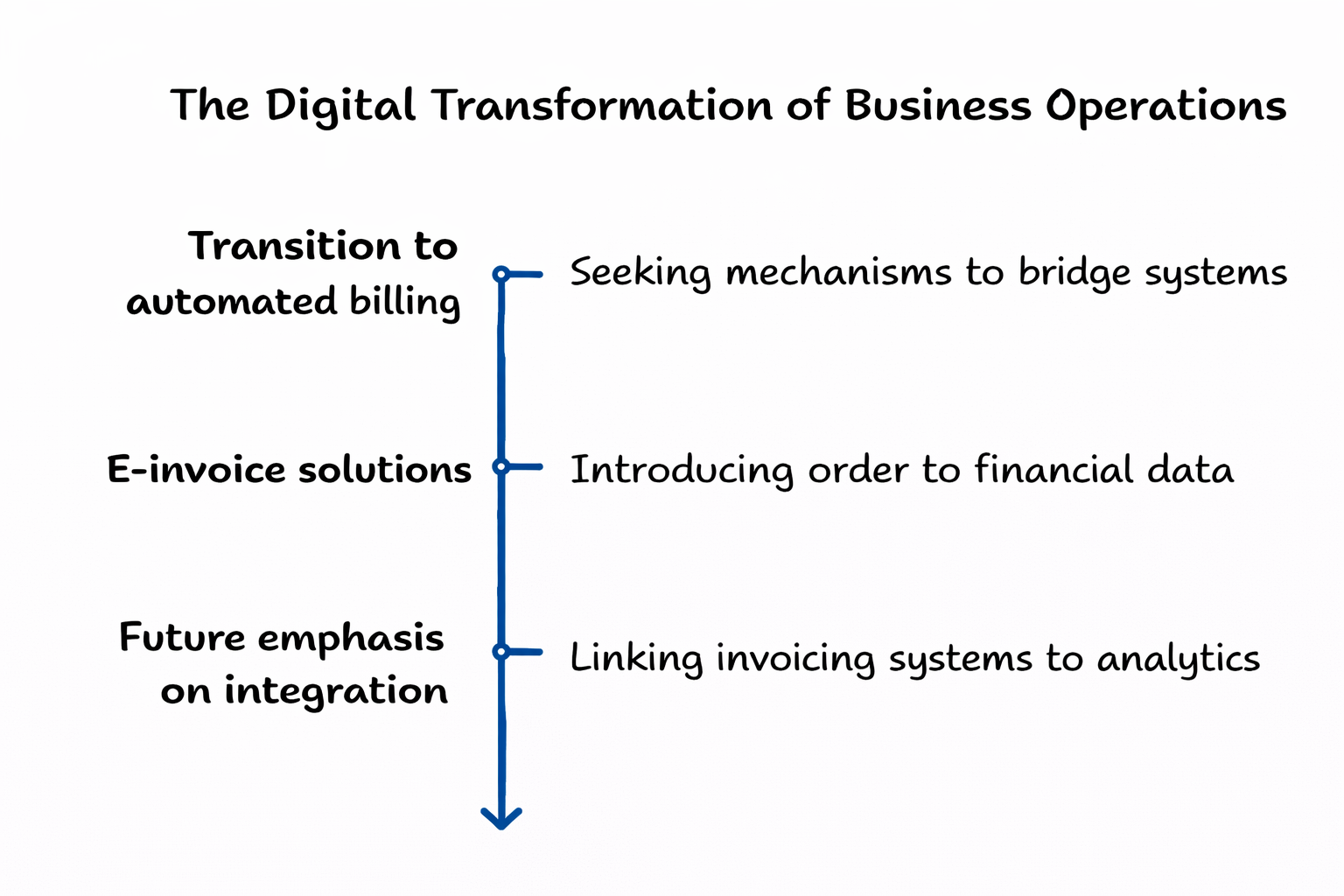
This transition to automated billing is among a bigger transition to a digital operation. Organizations are seeking mechanisms to bridge systems, minimize manual labor, and enhance decision-making
E-invoice solutions are well-placed in this direction. They introduce order to financial data and give operations a higher predictability.
In the future, more emphasis will probably be put on bigger integration. Invoicing systems will be linked to analytics tools more closely, which will give insights into the cash flow and customer behavior.
It is not only about efficiency, but also about smarter work in general.
Getting Started Without Overcomplicating Things
The simplest method is very often the best in the case of businesses that are thinking about automating e-invoices.
Begin by locating the places of delays or errors in your present process. Understanding related billing documents, such as a proforma invoice, can also help improve overall workflow clarity. Implement digital solutions to do away with such problems. It may be nothing more than switching to an online invoice maker.
From there, build gradually. Automate where it is appropriate. Measuring the effect and adjusting when necessary.
It is not necessary to rip everything up at the same time. It can be a small change that will bring significant outcomes in the long run.
Conclusion
E-invoice automation is not associated with getting people out or making it more complicated. It is concerned with the elimination of the friction that is dragging businesses behind. Using digital invoicing and automation, companies will be able to develop operations that are more efficient, precise, and less complicated.
The change is not one thing or the other; however, the way is obvious. Companies engaging in automation activities are in a position to deal with expansion, cash flow management, and have good customer relations.
Ultimately, the decision of selecting e-invoice systems is not about technology, but rather a question of smart working. And to business, which wishes to be efficient without causing extra work, that is one step that is worth making.
Ready to Turn Invoicing into a Seamless, Automated Process?
With e-invoice automation, you can eliminate manual delays, reduce errors, and keep your billing running smoothly without constant follow-ups. Start simplifying your workflow, accelerate payments, and build a more efficient business with smarter invoicing today.
Frequently Asked Questions
What is e-invoice automation and how does it differ from traditional invoicing?
E-invoice automation transforms billing into a digital, machine-readable process that pulls data directly from existing systems to generate, approve, and send invoices without manual intervention. Unlike traditional methods involving paper, printing, and hand-entry, it eliminates re-keying errors and integrates seamlessly with workflows for real-time processing.
How does e-invoice automation improve cash flow and payment cycles?
Automation sends invoices instantly upon transaction completion, reducing delays from manual dispatch and enabling faster client approvals. It includes automated reminders for overdue payments and real-time status tracking, shortening cycles and minimizing follow-ups. This leads to steadier cash flow, especially for small businesses handling frequent transactions.
What are common challenges in implementing e-invoice automation and how to overcome them?
Key hurdles include system integration issues, employee resistance to change, and data migration for legacy records. Start with a phased rollout—pilot in one department—while providing training to build buy-in and using tools with easy ERP compatibility. Over time, teams adapt as error reduction and time savings become evident.
What benefits can small businesses expect from e-invoice tools like invoice generators?
Small businesses gain cost savings by cutting paper, postage, and labor costs, plus error minimization through auto-calculations and templates. Tools standardize formatting, store client data for reuse, and speed up payments, freeing time for growth-focused tasks. Long-term, they enhance compliance with audit-ready digital trails.