
Why Digital Invoicing Systems Deliver Greater Billing Accuracy
2026-03-11
In every business, accuracy in billing is not just a financial concern. It is a matter of trust. A single miscalculated total or missing line item can delay payments, damage relationships, and create unnecessary stress for finance teams. That is why digital invoicing has become a central part of modern financial operations. Companies are realizing that billing accuracy is no longer optional, and manual systems are simply too fragile to support today’s demands.
As organizations grow, transactions multiply. With higher volume comes greater risk of error. Digital systems step in not just to speed up invoicing but to make it more precise, consistent, and transparent. Let us explore why the shift towards e-invoicing is happening and how it improves billing accuracy practically and measurably.
What Is Digital Invoicing?
Digital invoicing is the invention, delivery, and handling of invoices using electronic means as opposed to paper-based means. It encompasses formalized e-invoices, automated processes, and built-in accounting applications.
Contrary to a manual or handwritten document, a digital invoice is created using software that directly retrieves information based on sales records, contracts, or inventory. A large proportion of companies have an invoice generator or online invoice maker in order to generate professional and standardized invoices within a few minutes.
Digital invoicing may consist of:
- Automated tax calculations.
- Ready-prepared customer data.
- Integrated payment options.
- Real-time status tracking.
With more modern systems, the digital processing of invoices enables invoices to pass through approval processes automatically without human intervention. The idea is easy to achieve: minimize the number of human factors where errors are most probable.

Why Billing Errors Happen in Traditional Invoicing Systems
It is necessary to consider where traditional invoicing fails before knowing how digital systems contribute to accuracy.
Handling bills through manual means has many processes. An employee takes the data, inserts numbers in a template, counts the sums, adds taxes, and sends the invoice. Each step introduces risk.
Sources of billing errors are usually common as follows:
- Manual data entry mistakes.
- Incorrect tax calculations.
- Duplicate invoices.
- Lack of purchase order references.
- Pricing discrepancies.
- Misapplied discounts.
Payment delays may be caused by even minor mistakes. Studies show that structured billing workflows can help companies reduce accounting errors and save processing time. When a client notices something is wrong, they may hold their payment until the issue is explained and resolved. To businesses with a tight cash flow, such a delay can have ripple effects.
Changes are also not easily tracked using paper-based systems. In case an invoice is edited, it may lack a clear account of who did it and why. This is not transparency and makes audits and dispute resolution difficult.
With time, these inefficiencies build up. What appears to be a small administrative mistake is a repetitive working problem.
How Digital Invoicing Improves Accuracy
The digital invoicing systems are made to remove the weak links of manual billing. They decrease the usage of repetitive jobs and substitute them with standardized operations.
Structured billing systems improve financial processes by introducing standardized invoice formats and automated validation. E-invoices help reduce errors, maintain consistency in record-keeping, and lower operational costs by streamlining financial workflows.
Automatic Data Population
Digital systems retrieve data on related platforms instead of keying in information manually. As an example, after the sale is entered into the accounting system, an automatic generation of an invoice can be done using the same information.
This reduces the chance of:
- Entering incorrect amounts.
- Misspelling client names.
- Forgetting line items.
It is accurate since the system uses data sources that have been verified.
Built-In Validation Rules
A majority of online invoicing systems have validation. The system alerts to the problem by not sending the invoice when necessary fields are not provided, or totals are not correct.
This real-time feedback will avoid errors in reaching the client.
Consistent Formatting
There is a standard form of an electronic invoice. This will be critical in making sure that they capture all the details as required, including tax identifiers, payment terms, and descriptions of the items. It makes it easier to be consistent and eliminate confusion and conflict.
Concisely, digital systems minimize variability. Reduced variability implies reduced errors.

The Role of Invoice Automation in Reducing Human Error
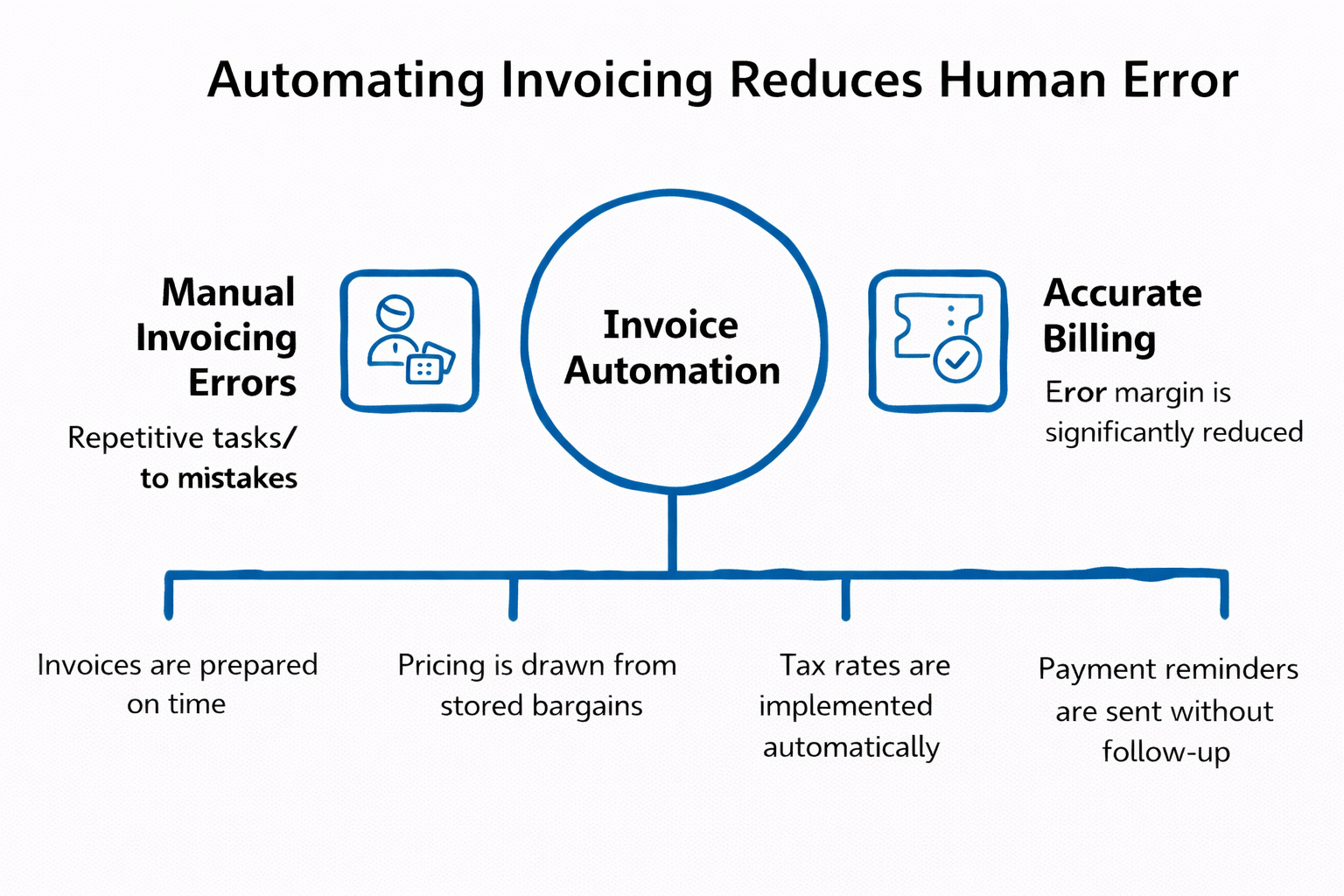
Automation of invoicing assumes a key role in enhancing the accuracy of billing. The error margin is reduced when repetitive jobs are automated.
Take into account periodic invoices on the basis of subscription. With a manual system, one has to remember to make up and send the invoice every month. They will have to verify the prices, dates, and taxes.
With invoice automation:
- Invoices are prepared on time.
- Pricing is drawn out of stored bargains.
- Tax rates are implemented automatically.
- Payment reminders are sent without any manual follow-up.
The procedure becomes predictable and similar. The employees do not need to go through the same calculations many times; thus, fatigue errors are minimized. Automated billing workflows are closely related to automatic invoicing systems that remove repetitive manual tasks.
Workflows on approval are also automated. The automated routing of invoices to the concerned manager allows them to be viewed. This makes sure that it runs smoothly without creating bottlenecks.
Processing of Invoices digitally and manually
The differences between digital processing of invoices and manual processing can be seen explicitly when attempting to look at daily operations.
Manual Processing
Accounts payable teams, under a manual system, are sent the invoices either through mail or email. They check the document, fill in the accounting system, check purchase orders, and request their approval.
This approach often leads to:
- Slow processing times.
- Data entry inconsistencies.
- Poor visibility of invoice status.
- Increased administrative load.
Every shift of workers raises the chance of lateness or negligence.
Digital Invoice Processing
In the digital system of processing invoices, the invoices are sent to a structured format that can be read automatically by the system. Information is not typed manually. Electronic matching occurs between purchase orders.
Benefits include:
- Faster verification.
- Real-time tracking.
- Reduced processing costs.
- Lower error rates.
As an illustration, a medium-sized distribution firm that handles hundreds of invoices weekly can save a lot of time that would otherwise be spent correcting discrepancies in the event of transition to digital systems. The system will compare figures and not manually check each figure, as is the case.
The difference is not subtle. It transforms the day-to-day operations of finance teams.
Benefits of Using an Invoice Generator or Online Invoice Maker
Enterprise software might not be necessary for small businesses and freelancers. Nonetheless, such programs, such as an invoice generator or online invoice maker, can improve the level of accuracy considerably.
These tools help by:
- Offering pre-designed templates.
- Total numbers are automatically calculated.
- The correct application of tax rates.
- Saving of client information in a secure place.
Suppose that a little consulting company has to issue ten invoices a month. Unless automation is used, a simple mistake in calculations may cause embarrassing moments with customers. The online invoice maker allows the firm to be professionally formatted and use correct totals in every instance.
These tools are easy to use and thus make digital invoicing applicable to any business, regardless of size. Sometimes accuracy does not need to be costly in terms of technology. Choosing the right solution is important when selecting e-invoice software for business use.
Compliance, Transparency, and Audit Readiness
The accuracy of billing is also very much related to e- invoice compliance. To provide adequate tax filing, governments are pushing to have structured e-invoice reporting.
The electronic invoicing assists in compliance in the following ways:
- Calculation of tax automatically with current regulations.
- Individual audit trails of edits and approvals.
- Online safe storage of records.
- Standardized data formats.
Digital systems enable instant access when an auditor asks to be provided with documentation. No one has to rummage through the filing cabinets or archived e-mail messages.
Internal accountability is also enhanced with transparency. Managers are able to check on the approver of an invoice and the time. Such transparency minimizes conflict and enhances internal regulation.
Precision is not merely regarding right sums. It has to do with traceability and reliability.
Real World Business Scenarios: How Companies Reduce Billing Mistakes
Take an example of a manufacturing firm that distributes to a number of retailers. Different terms of prices and shipping might be applied to each order. When using a manual system, there is a high chance of making the wrong pricing.
Having implemented the digital invoicing that is embedded in its sales system, the organization connects every invoice with an initial purchase order. Its terms and prices are drawn automatically. Controversies surrounding billing are reduced significantly after a few months.
In a different case, a marketing company charging clients on a project basis was experiencing problems in tracking billable hours. There are occasions when team members omit some tasks. The combination of time tracking software and electronic invoice software has allowed the company to transfer all hours recorded to the invoice draft. Nothing is overlooked.
These situations bring out a major fact. Systems that interact with one another increase the degree of accuracy.

Common Challenges and How Businesses Address Them
Although there are benefits, there could be problems with the process of switching to digital invoicing.
Resistance to Change
Staff who are used to working with manual procedures will be reluctant to use new tools. Clearness of communication and training is very necessary. Showing the way automation saves a lot of work is a way of developing acceptance.
Integration Concerns
The connection with the modern platforms may not be easily made with the older accounting systems. This is usually met with software upgrades or collaboration with qualified implementation partners by the business.
Data Migration
The transfer of historical records to another system has to be carefully planned. Phased implementation is used by many companies to minimize disruption.
These issues are short-term and can be dealt with when adequately prepared. The benefits of the long-term accuracy are greater than the adjustment period.
The Future of Electronic Invoice Systems
Electronic invoice systems are still developing. The governments across the globe are implementing compulsory electronic reporting conditions. Formatted e-invoices are emerging as the norm in most areas.
Digital invoice processing is also being enhanced by the advancement of analytics and artificial intelligence. It is now possible to identify anomalies, flag unusual patterns, and predict cash flow trends through invoice data using systems.
With the growing regulatory requirements, a business that is based on manual systems will be disadvantaged. Getting things right, fast, and transparent has become the norm, and not a competitive edge.
Digital invoicing is no longer on the one hand only a convenience. It forms the basis of contemporary financial management.
Practical Tips for Implementing Digital Invoicing Successfully
When organizations are contemplating the transition, a contemplative solution makes the results less turbulent.
Evaluate Your Current Workflow.
Determine the most common mistakes. Is it in data entry, calculation of tax, or approval?
Choose Scalable Tools
Choose a system that is integrated with your accounting platform that can expand with your business.
Start With Core Functions
Start with invoice creation and slowly extend to invoice automation and processing of the digital invoice.
Train Your Team
Conduct practical training so that the employees know how to utilize the system.
Monitor Accuracy Metrics
Track error rates, after implementation delays on payments, and frequency of disputes before and after implementation. This aids in gauging improvement and process refinement.
Formal implementation minimizes risk, and confidence is created throughout the organization.
Conclusion
Financial stability and professional credibility are based on billing accuracy. The manual systems of invoicing, though not unknown, give too many opportunities to fail. With the increased transaction levels and stringent compliance regulations, business organizations require more stable or effective solutions.
E-invoicing provides that security. It greatly eliminates billing errors through automation of data entry, format standardization, integration of systems, and the provision of audit trails. It makes no difference whether this is enterprise-level digital invoice processing or just a simple online invoice maker; the difference is evident.
Companies adopting the use of electronic invoice systems put themselves in a better position to be more efficient, compliant, and to gain better client trust. Digital invoicing is a viable and future-proof solution in a business setup where accuracy is more important than ever before.
Ready to Simplify Your Billing with Professional PDF E-Invoices?
With PDF Invoicing, you can create, customize, and download polished e-invoices and proforma invoices in just a few clicks, no complicated software, no guesswork, and even add payment links to get paid faster. Start generating accurate, branded PDF invoices instantly and take control of your invoicing process today!
Frequently Asked Questions
1. How does digital invoicing improve billing accuracy compared to manual invoicing?
Digital invoicing pulls line items, prices, and tax rates directly from integrated sales or accounting systems, so data is not re‑typed by hand. It applies built‑in validation rules, standardized templates, and automated calculations, which significantly reduce common errors like wrong totals, duplicate invoices, misapplied discounts, and missing purchase‑order references.
2. Why are billing errors more common in traditional paper‑based invoicing?
Traditional paper‑based invoicing relies on manual data entry, transcription, and arithmetic, which are prone to typos, missed line items, incorrect tax rates, and duplicate entries. These mistakes are harder to catch quickly, and each change or correction often lacks a clear audit trail, making disputes and audits more difficult.
3. What are the main benefits of using an online invoice generator or invoice maker?
An online invoice generator or invoice maker automatically calculates totals, applies correct tax rates, and saves customer data so it is reused consistently across invoices. This reduces manual keying, improves formatting consistency, and helps small businesses and freelancers issue professional, accurate invoices without investing in complex enterprise software.
4. How does digital invoicing support compliance and audit readiness?
Digital systems store invoices in structured formats with timestamps, user IDs, and audit trails, so every edit and approval is traceable. Many platforms also ensure real‑time tax compliance and automatic reporting, which makes it much easier to produce documentation quickly during audits or regulatory checks.
5. What challenges do businesses face when switching to digital invoicing, and how can they overcome them?
Common challenges include employee resistance to new tools, integration with existing accounting software, and migration of legacy data. Businesses overcome these by starting with core features (like digital invoice creation), providing hands‑on training, using phased rollouts, and choosing scalable, compliant platforms that integrate smoothly with mainstream accounting suites.